Financial Stress Forecast

Financial Stress
Among Consumers
Financial stress, a pervasive issue affecting many individuals, can lead to anxiety, depression, and even physical health problems. The Financial Stress Forecast and Debt Burden Scale are invaluable tools for understanding the extent of this problem and predicting potential economic downturns. By providing insights into Americans’ financial behaviors and attitudes, these metrics enable policymakers, financial institutions, and individuals to take proactive measures to mitigate financial hardship and promote overall economic stability.

The Current Forecast
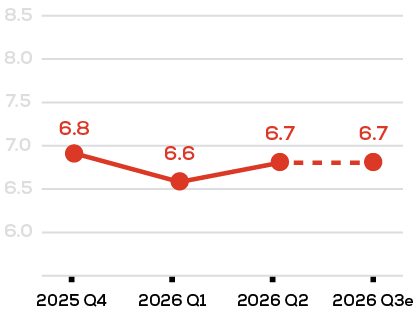
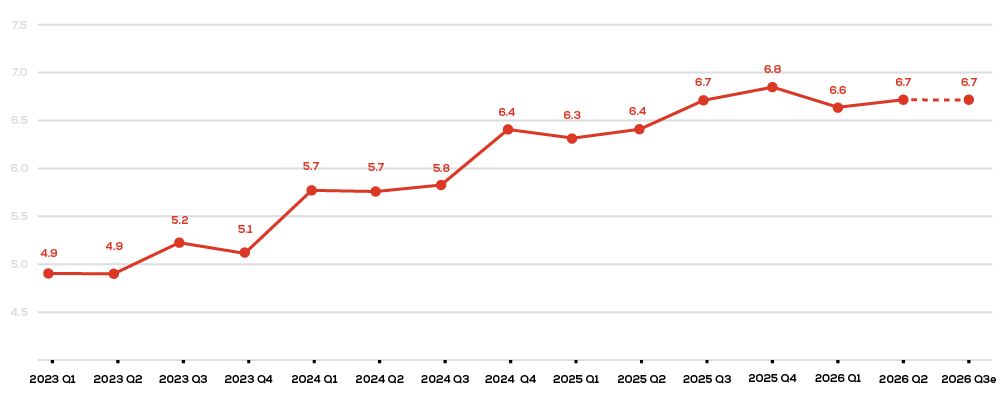
The NFCC Financial Stress Forecast (FSF) increased slightly to 6.7 in 2026Q2, matching last quarter’s projection and confirming that U.S. households remain locked into an extended period of elevated financial strain. The forecast also points to 6.7 in 2026Q3, the third straight quarter in the 6.6–6.8 range. Rather than easing, this steady reading suggests debt burdens, tight cash flow, and limited financial flexibility have become a fixture of household finances rather than a temporary condition. Compared with the post-pandemic low of 3.5 in 2021, the current forecast points to a consumer landscape that is far more financially constrained.
Key Insights from the Q3 Forecast:
- Forecast Held Steady: The FSF reached 6.7 in 2026Q2, exactly as projected last quarter, and is expected to hold at 6.7 in Q3. The model’s accuracy continues to bear out — and what it’s showing is elevated stress that isn’t budging.
- Debt Conditions Improve, Credit Reliance Grows: NFCC’s proprietary debt measures have ticked up modestly over the past two quarters, but revolving credit outstanding climbed from $1.06 trillion to $1.08 trillion over the same period. Consumers are managing existing debt a little better, while leaning more heavily on credit to get by.
- Financial Cushion Has Worn Thin: Since bottoming out at 3.5 in 2021, the FSF has climbed steadily and now appears to have settled near 6.7. That plateau isn’t a sign of recovery — it reflects a household financial position that is materially weaker than it was before, with less room to absorb an unexpected expense.
The Forecast History
How it works.
The NFCC Financial Stress Forecast can predict delinquency rates among consumers with credit card debt.
It gives insight on the federal reserve delinquency and charge off rates for the upcoming quarter with 95% accuracy.
The NFCC Financial Stress Forecast serves as a critical early warning indicator of potential economic instability.
National Foundation
for Credit Counseling
Founded in 1951, the National Foundation for Credit Counseling is the oldest nonprofit dedicated to improving people’s financial well-being. With 1,215 NFCC Certified Credit Counselors serving 50 states and all U.S. territories, NFCC nonprofit counselors are financial advocates, empowering millions of consumers to take charge of their finances through one-on-one financial reviews that address credit card debt, student loans, housing decisions, and overall money management.